


Last Updated: October 29, 2026
Quick Summary
Recruiting for dual skill sets means hiring people who can do two jobs well, not one job perfectly and another badly. Define the pairing before you write the job description, source multi-disciplinary candidates beyond standard job boards, and test both halves in the interview before an offer goes out.
- Split the role into primary, secondary, and deal-breaker skills with the hiring manager before sourcing begins.
- Score candidates on both skill axes and record the lower score as the dual-skill floor.
- Structure interviews into primary, secondary, and intersection blocks of 10 minutes each.
- Track time to full productivity, retention at 90 days and one year, and manager ratings on each skill.
- Treating dual skill as twice as much experience is the biggest mistake in dual-skilled hiring.
Table of Contents
- Why Dual Skill Sets Matter in Technical Hiring
- Step 1: Define the Dual Skill Combination Before You Write the Job Description
- Step 2: Source Multi-Disciplinary Candidates Beyond Standard Job Boards
- Step 3: Assess Transferable Skills and Spot Skill Gaps During Screening
- Step 4: Use Interview Questions for Hybrid Roles to Test Both Skill Sets
- Step 5: Track How to Improve Quality of Hire Metrics for Dual-Skilled Hires
- Common Mistakes When Recruiting for Dual Skill Sets
- Build Your Dual-Skilled Talent Pipeline with IntegrityJobs
- Frequently Asked Questions
Why Dual Skill Sets Matter in Technical Hiring
Recruiting for dual skill sets means hiring people who can do two jobs well, not one job perfectly and another badly. Plants and engineering teams often lose time and money when a hire covers only half of what the role actually demands. Building this versatile workforce often begins at the entry level through strategic college recruiting, which allows organizations to identify candidates with the foundational aptitude to master multifaceted responsibilities.
A machinist who can also read a quality inspection report saves a handoff.
The problem is that most hiring processes are built for single-skill roles. Job descriptions list one core requirement. Screening checks one box. Interviews test one strength.
Dual-skilled hiring flips that. You define the combination first, source for it on purpose, and test both halves before an offer goes out.
Step 1: Define the Dual Skill Combination Before You Write the Job Description
Start with the pairing, not the posting. Before you write a single line of the job description, name the two skills the role truly needs and how often each gets used.
A common mistake is listing every skill the team wishes it had. That produces a job description nobody qualified will answer.
- Primary skill: the work the hire does most days.
- Secondary skill: the work that comes up weekly or in bursts.
- Deal-breaker skill: the one thing the person cannot lack.
Write these down with the hiring manager before sourcing begins. When you draft the posting, effective machinist job descriptions help you state the combination clearly so the right hybrid candidates self-select in.
Step 2: Source Multi-Disciplinary Candidates Beyond Standard Job Boards
Job boards reach people who are actively looking. Multi-disciplinary candidates often are not. They are already employed, and they scan for roles that match their full range, not just their job title.
So widen the channel mix:
- Trade schools and community college programs that turn out cross-trained graduates.
- Apprenticeship and internship pipelines feeding technical roles.
- Employee referrals, which tend to surface people with adjacent skills.
A practical skilled trades recruiting guide helps you build these channels into a repeatable process instead of a one-off search. The point is to reach candidates before they hit a job board, when your role can still shape their interest.
Step 3: Assess Transferable Skills and Spot Skill Gaps During Screening
Resume screening is where dual-skill searches usually break down. A resume lists job titles, and titles hide combinations. A candidate labeled “maintenance tech” may also hold real CNC experience that never made the summary line. Most competitors stop at “read for skills, not titles” and leave you without a way to score what you find. The rubric below closes that gap.
Build a two-axis scoring grid before you open a single resume
List the two skills the role requires across the top of a spreadsheet. Down the left side, list the evidence levels. Score every candidate on both axes independently, then record the lower of the two scores as the candidate’s “dual-skill floor.” That floor, not the average, is what predicts whether the hire can cover the whole role.
| Evidence level | What you are looking for | Score |
|---|---|---|
| Proven | Named role, dated project, or certification that directly demonstrates the skill | 4 |
| Adjacent | Related work that shortens ramp-up (a welder who reads blueprints; an electrician who troubleshoots PLCs) | 3 |
| Claimed | Listed on the resume with no supporting detail | 2 |
| Absent | No evidence either way | 1 |
A candidate who scores 4 on machining and 2 on quality inspection has a dual-skill floor of 2. That is a screening flag, not a rejection: it tells you exactly which half to probe in the interview.
Separate transferable skills from gaps with three questions
For each skill axis, ask:
- Does the evidence name a tool, system, or output? “Ran a HAAS lathe” beats “machine operation.” Specific nouns are hard to fake.
- Is the adjacent skill close enough to transfer? Reading blueprints transfers to quality inspection; welding does not transfer to PLC programming. Map the distance before you credit it.
- What is the ramp-up cost? A candidate missing the secondary skill but strong on the primary may still be the best hire if the secondary skill can be taught in weeks, not months.
Worked example
Suppose the role is a maintenance technician who must also handle basic PLC troubleshooting. Candidate A lists ten years of mechanical maintenance and one line about “supported controls upgrades.” Candidate B lists four years of maintenance and a completed PLC certificate with a dated capstone project. Candidate A scores 4 mechanical / 2 controls (floor 2). Candidate B scores 3 mechanical / 4 controls (floor 3).
Score the grid before the phone screen, then update it after. The change between the two scores shows you which claims held up under questioning and which were resume polish.
Score every candidate on both halves before the interview. That grid becomes your shortlist, and it stops one strong skill from hiding a weak second one.
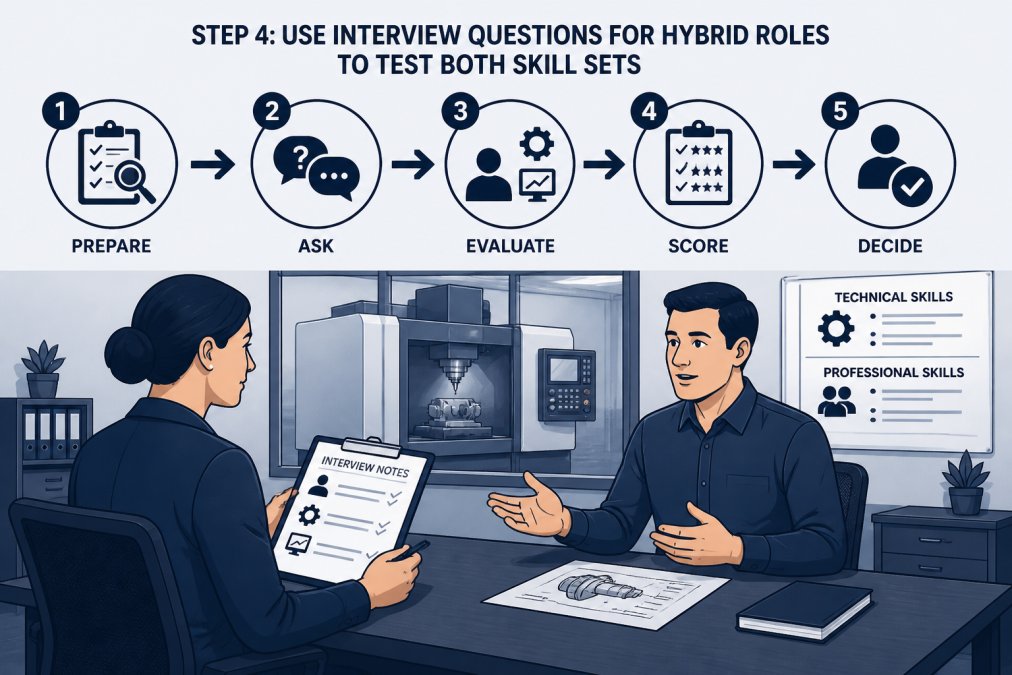
Step 4: Use Interview Questions for Hybrid Roles to Test Both Skill Sets
An interview for a hybrid role has to test both halves, not just the louder one. Structure the conversation so each skill gets its own block of questions, then add one question that forces the candidate to connect them. Competitors list sample questions and stop there.
Block 1: Primary skill depth (10 minutes)
Ask for a specific project with a measurable outcome.
- “Walk me through the last time you set up a machine from scratch. What did you check first, and what went wrong?”
- “What is the most common failure you see in your primary skill area, and how do you catch it early?”
Listen for named tools, sequences, and numbers. A candidate who has real depth will correct your assumptions and describe trade-offs.
Block 2: Secondary skill depth (10 minutes)
Use the same structure, but accept adjacent evidence. The goal is to find the edge of their knowledge, not to disqualify them.
- “Tell me about a time you had to read a quality inspection report or a controls diagram. What did you do with it?”
- “When was the last time you had to learn a second skill area on the job? How did you get up to speed?”
Block 3: The intersection question (10 minutes)
This is the block competitors skip. It tests whether the candidate can hold both skills in mind at once.
- “Walk me through a time you caught a quality issue while running a machine. What did you do next?”
- “How do you decide when a programming change needs a quality check before the run?”
- “Tell me about a job where you had to switch between two skill areas in the same shift. What did the handoff cost you?”
A candidate who has truly worked both sides will describe real handoffs, real conflicts, and real fixes. A candidate who has only done one side will stay vague on the other, or answer the intersection question entirely from one domain.
Score each block on a 1-4 scale
Use the same evidence levels as your screening grid: 4 for a specific, dated example with an outcome; 3 for a plausible example with thin detail; 2 for a general answer with no example; 1 for no answer or a contradiction. Record three scores per candidate: primary, secondary, and intersection. The intersection score is the one that separates a true dual-skilled hire from a specialist who has read about the other half.
Do not let a strong primary-skill answer bleed into the secondary score. Score each block immediately after it ends, before the next block begins, or the halo effect will flatten the difference.
The intersection block is the highest-signal part of the interview. If a candidate cannot describe a single moment where the two skills interacted, treat the second skill as unproven regardless of what the resume says.
Listen for specifics. A candidate who has truly worked both sides will describe real handoffs, real conflicts, and real fixes. A candidate who has only done one side will stay vague on the other.
Step 5: Track How to Improve Quality of Hire Metrics for Dual-Skilled Hires
You cannot improve what you do not measure. Track quality-of-hire metrics for dual-skilled roles the same way you would for any critical position, but add a check on both skills.
Track these:
- Time to full productivity: how long until the hire handles both skill areas alone.
- Retention at 90 days and one year: dual-skilled hires who feel underused tend to leave early.
- Manager rating on each skill: score both halves, not one blended number.
For a deeper method, how to improve candidate quality in technical hiring walks through clearer requirements, targeted screening, and faster feedback loops. Review the numbers after every hire and adjust the job description and screening grid to match.
Common Mistakes When Recruiting for Dual Skill Sets
The biggest mistake is treating “dual skill” as “twice as much experience.” It is not. It is two related skills used together, and the best hires often have solid depth in one and working depth in the other.
Other mistakes we see:
- Testing only the primary skill in the interview, then hoping the second one shows up on the job.
- Writing a wish-list job description that scares off qualified hybrid candidates.
- Skipping the skill-gap check and discovering the gap after the start date.
If slow hiring is your pattern, steps to reduce hiring time without bad hires show how to speed decisions without lowering the bar. Speed and quality are not opposites when the screening grid is tight.
Build Your Dual-Skilled Talent Pipeline with IntegrityJobs
Dual-skilled hiring rewards teams that define the pairing, source on purpose, and test both halves. Do that, and you stop paying for skill gaps after the hire.
IntegrityJobs has placed technical talent for 30 years. IntegrityJobs focuses on engineering, manufacturing, IT, and skilled trades roles, with flexible contract and contract-to-hire options, and covers all 88 Ohio counties.
Ready to find a candidate who covers both sides of the role? Browse current technical job openings and start building your pipeline today.
Frequently Asked Questions
What are the benefits of hiring candidates with dual skill sets?
Hiring candidates with dual skill sets gives you more flexibility in how you deploy staff and can reduce the need to fill two separate roles. In manufacturing and technical settings, a worker who can handle both CNC programming and quality inspection, for example, keeps production moving when one area gets busy. Dual-skilled hires also tend to stay longer because they have more room to grow, which supports better talent retention and lowers turnover costs over time.
How do you write a job description for a dual-skilled role?
Start by naming the two skill areas clearly and ranking them: which is primary and which is secondary. List the specific tools, certifications, or processes the person must know rather than vague phrases like ‘technical proficiency.’ Describe the split in daily work, such as ‘70% CNC programming, 30% quality inspection.’ Keep the must-have list short so you do not screen out strong candidates who can learn the secondary skill on the job.
How do you assess dual skill sets during the interview process?
Use a two-part interview: one segment for each skill area, run by someone who does that work. Ask for concrete examples of past projects where the candidate used both skills together. Add a short practical exercise, such as reading a drawing and then explaining how they would inspect the finished part. Score each skill separately on a simple rubric so you can see whether the candidate is strong in both or only one.
Is skills-based hiring effective for specialized manufacturing roles?
Yes, when the assessment is tied to the actual work. For specialized roles like machinists and technicians, skills-based hiring means testing the specific operations the job requires, not just reviewing resumes for degrees. It widens your talent pool because it lets you consider candidates who have the hands-on ability but not the traditional credential. Pair it with a structured interview and a paid trial or contract-to-hire period to confirm the fit.
The real test of a dual-skilled hire is whether both skills show up on the floor, not just on the resume. That takes a defined combination, a screening grid, and an interview that tests each half. IntegrityJobs brings 30 years of technical recruiting, a vetted talent pool, and flexible contract-to-hire options to that work. Get started with IntegrityJobs and build a pipeline of candidates who cover the full role.