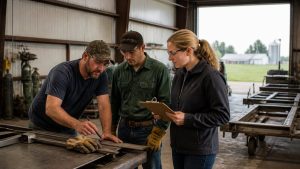


A maintenance supervisor quits on Tuesday, production is already behind by Thursday, and HR is staring at a stack of resumes that do not match the job. That is usually when the question comes up: staffing agency vs recruiter – which one actually solves the problem faster and with less risk?
The short answer is that they are not the same, and the right choice depends on the role, the urgency, and how much precision the hire requires. For engineering, manufacturing, and skilled labor positions, that distinction matters more than most companies realize. A bad hire in a plant, on a line, or in a technical department does not just waste recruiting dollars. It affects output, safety, training time, and team morale.
Staffing agency vs recruiter: what is the difference?
A staffing agency typically helps companies fill roles across a range of employment types. That can include temporary, temp-to-hire, and direct-hire positions. In many cases, a staffing agency keeps an active bench of candidates and can move quickly when an employer needs workers on short notice.
A recruiter, on the other hand, is usually associated with targeted search and direct placement. The recruiter may work independently or as part of a recruiting firm, but the core job is to identify, qualify, and present candidates for a specific opening. That process is often more consultative and more selective, especially for specialized technical roles.
The confusion comes from the fact that many firms do both. A specialized partner may provide staffing support for urgent production needs while also handling recruiter-style searches for engineers, supervisors, maintenance leaders, or hard-to-find skilled trades professionals. That is why the label matters less than the actual service model.
When a staffing agency makes the most sense
If your need is immediate and volume-driven, a staffing agency can be the better fit. This is common when a manufacturer needs machine operators, assemblers, warehouse support, or entry-to-mid-level production talent to keep operations moving. The value is speed, process, and access to an existing candidate pipeline.
For employers, this approach can reduce the pressure on internal HR teams. Screening, scheduling, onboarding coordination, and attendance tracking may all be part of the service. If demand fluctuates, temp or temp-to-hire staffing can also give a company more flexibility before making a long-term commitment.
For job seekers, staffing agencies can open doors quickly. Someone with machining experience, forklift certification, welding skills, or quality background may get in front of employers faster through a staffing partner than through cold applications alone.
That said, speed has trade-offs. If the role requires deep technical knowledge, a complex reporting structure, or highly specific experience, a general staffing model may not be enough. Fast is useful, but only if the candidate can actually do the job.
When a recruiter is the better choice
A recruiter is usually the better option when the role is harder to fill, more specialized, or more important to long-term performance. Think controls engineers, manufacturing engineers, plant managers, maintenance managers, quality leaders, CNC programmers, and other positions where the cost of a mismatch is high.
In those cases, the work is not just about finding available people. It is about understanding the technical demands of the job, the culture of the company, the compensation reality in the market, and what will motivate the right candidate to make a move.
Good recruiters also spend more time qualifying fit. They look beyond keywords on a resume. They ask whether the candidate has worked in the right production environment, handled the right equipment, led the right size team, or solved the right type of operational problem. That level of detail is where specialized recruiting earns its value.
For candidates, recruiter support can also be more strategic. Instead of being routed into a broad applicant pool, they may be considered for roles that genuinely match their background, income goals, and career direction.
The real issue is specialization
For technical hiring, the bigger question is often not staffing agency vs recruiter. It is whether the partner understands the industry well enough to represent the role accurately.
An engineering manager does not want to explain the difference between a design engineer and a manufacturing engineer three times to three different vendors. A plant leader does not have time to review resumes from candidates who have never worked in an industrial setting. Skilled trades professionals do not want calls about jobs that sound similar on paper but are clearly wrong once the details come out.
This is where specialization changes the outcome. A firm that works specifically in engineering, manufacturing, and skilled labor hiring can usually screen more effectively, communicate more clearly, and present stronger matches. That is especially true in competitive markets where good candidates have options and employers cannot afford delays.
What employers should look at before choosing
If you are hiring for Ohio industrial or technical roles, start with the nature of the opening. Is the need temporary, seasonal, or tied to production swings? A staffing model may be ideal. Is the position specialized, confidential, or difficult to replace? A recruiter-led search may be the smarter move.
You should also look at the internal burden. Some companies need a partner who can simply send people fast. Others need a partner who can act as an extension of the hiring team, help shape the search, screen for technical fit, and keep candidates engaged through the process.
Fee structure matters, but it should not be the only factor. A lower-cost option that produces weak candidates, no-shows, or repeated turnover is usually more expensive in the long run. In manufacturing especially, every hiring mistake has a ripple effect across output and leadership time.
Ask practical questions. How does the firm source candidates? How do they screen for technical ability? Do they understand your environment? Can they speak credibly about shift structure, plant culture, equipment, certifications, and progression paths? If they cannot, they will struggle to attract the right people.
What job seekers should pay attention to
Candidates should evaluate staffing firms and recruiters the same way employers do – by relevance and honesty. If a recruiter does not understand your trade, your engineering discipline, or the kind of environment you want, the conversation will waste your time.
A good partner should be able to explain the role clearly, including pay range, schedule, location, reporting line, and what the employer actually needs. Vague job pitches are a warning sign. So is poor communication after the first call.
For many technical professionals, the best recruiting experience comes from a specialist. Someone who knows the local manufacturing market, understands plant operations, and can tell the difference between a strong fit and a forced fit is more likely to present real opportunities instead of generic openings.
Why many companies need both
There are plenty of situations where the best answer is not one or the other. A manufacturer might use staffing support to keep the floor covered while using a recruiter to fill a key maintenance leadership role. A growing company might need contract technicians now and a direct-hire engineer next month.
That blended approach is often the most realistic one, especially for employers dealing with labor shortages, growth, or turnover in multiple parts of the business. The key is working with a partner that is transparent about what they do well and does not force every search into the same box.
For employers and candidates in Ohio, that often means choosing a firm with real technical recruiting experience, not just resume volume. IntegrityJobs.com is built around that model, with a focus on engineering, manufacturing, and skilled labor hiring where accuracy and speed both matter.
The bottom line on staffing agency vs recruiter
If you need fast access to workers for flexible or high-volume hiring, a staffing agency can be the right tool. If you need precision, market insight, and a stronger vetting process for a specialized role, a recruiter is usually the better fit.
But in technical hiring, titles can be misleading. What matters is whether the partner understands the work, respects your time, and consistently brings the right people to the table. That is what turns hiring support into a real advantage.
The best choice is the one that makes your next hire easier, more accurate, and more likely to last.