


Last Updated: October 28, 2026
Quick Summary
Technical staffing for Ohio manufacturing plants means sourcing, screening, and placing skilled workers in roles requiring specialized training, certification, or engineering judgment. It covers three tiers: production and general labor roles, skilled trades and maintenance roles, and engineering and technical roles. IntegrityJobs has spent 30 years placing technical talent across Ohio.
- Match the staffing model to the planning horizon, from temporary labor to direct hire for engineers.
- Temp-to-hire lets you evaluate skilled trades and maintenance fit on the floor before converting.
- Verify identity, safety history, credentials, and skills before a candidate walks your floor.
- Ask what the pay rate to the worker is separately from the bill rate.
- A slightly higher fee with a longer guarantee can be cheaper than a low fee with a 30-day window.
Table of Contents
- What Technical Staffing Covers in a Manufacturing Plant
- Manufacturing Workforce Planning: Build the Staffing Plan Before the Requisition
- Maintenance Technician Staffing: The Role That Decides Your Uptime
- Manufacturing Engineering Recruiters: Where the Hardest Searches Get Won
- Choosing a Manufacturing Staffing Agency: Evaluation Criteria and Cost Models
- Screening, Safety, and Credential Verification Before Anyone Walks the Floor
- Retention, Attendance, and Quality: Measuring Whether the Hire Actually Worked
- Building Your Plant Staffing Plan with IntegrityJobs
- Frequently Asked Questions
What Technical Staffing Covers in a Manufacturing Plant
Technical staffing for Ohio manufacturing plants means sourcing, screening, and placing skilled workers in roles requiring specialized training, certification, or engineering judgment. At IntegrityJobs, we have spent 30 years placing technical talent across Ohio.
General labor staffing fills hands; technical staffing fills capability. A controls engineer who misreads a PLC ladder logic change, or a maintenance technician who skips a lockout/tagout step, creates downtime and liability that far outweighs a slower hire.
Roles Plants Fill Through Technical Staffing
The roles split into three tiers.
Production and general labor roles. Assemblers, machine operators, material handlers, and packaging staff.
Skilled trades and maintenance roles. Maintenance technicians, industrial electricians, millwrights, welders, and CNC machinists.
Engineering and technical roles. Manufacturing engineers, mechanical and electrical engineers, controls engineers, process engineers, industrial engineers, quality engineers, and automation and robotics specialists.
How the Placement Process Works
Sourcing pulls from active candidates, passive skilled trades workers, and referral networks. The cycle compresses dramatically when intake is specific.
Manufacturing Workforce Planning: Build the Staffing Plan Before the Requisition
The biggest mistake in plant hiring is opening a requisition before mapping the workforce need behind it.
Start with three questions. Which roles are production-critical if vacant for two weeks? Which require skills that take months to replace? Which have predictable turnover, so you can plan the backfill before the resignation lands?
| Planning Horizon | Role Type | Recommended Staffing Model | Why |
|---|---|---|---|
| 0-30 days | General labor, production workers | Temporary staffing | Demand spikes and short absences |
| 1-3 months | Skilled trades, maintenance technician | Temp-to-hire | Lets you evaluate fit on the floor |
| 3-12 months | Engineers, controls, automation | Direct hire or contract-to-hire | Long ramp, high replacement cost |
| Seasonal peak | Mixed production staffing | Flexible staffing blend | Scales up and down without headcount risk |
Maintenance Technician Staffing: The Role That Decides Your Uptime
If you want to benchmark what these roles look like on the candidate side, our guide to machine maintenance technician jobs Ohio breaks down the skills, pay factors, and application steps employers are competing against.
Manufacturing Engineering Recruiters: Where the Hardest Searches Get Won
For a fuller picture of how these searches run, see our breakdown of how engineering recruitment works in Cincinnati, Ohio.
Choosing a Manufacturing Staffing Agency: Evaluation Criteria and Cost Models
Fill speed.
Screening depth.
Geographic reach.
Cost structure.
Staffing Models Compared: Temp, Temp-to-Hire, and Direct Hire
| Model | How It Works | Best For | Trade-off |
|---|---|---|---|
| Temporary staffing | Agency employs the worker; you pay an hourly bill rate | Demand spikes, absences, seasonal peaks | No long-term retention; repeated onboarding cost |
| Temp-to-hire | Worker starts on agency payroll, converts to yours after a set period | Skilled trades and maintenance roles where fit matters | Conversion fee applies; slower start than direct hire |
| Direct hire | Agency recruits and you hire onto your payroll immediately | Engineers, supervisors, hard-to-fill technical roles | Highest upfront fee; least flexibility if the hire fails |
| Contract-to-hire | Worker is contracted for a defined term with an option to convert | Engineering and controls roles with uncertain long-term need | Requires clear conversion terms up front |
What Actually Drives the Total Cost of a Placement
- Bill rate or placement fee. For temporary and contract roles, the hourly bill rate bundles the worker’s pay, payroll taxes, workers’ compensation, and the agency’s margin. Ask what the pay rate to the worker is separately from the bill rate, the spread is where agencies differ most.
- Conversion fee. Temp-to-hire and contract-to-hire arrangements typically carry a conversion fee when you hire the worker onto your payroll, often a percentage of annual salary or a flat amount that declines the longer the worker has been on assignment. Get the schedule in writing before the start date.
- Re-hire and replacement cost. If a placement fails inside the guarantee window, the replacement may be free, but the downtime, onboarding, and lost productivity are not. A slightly higher fee with a longer guarantee can be cheaper than a low fee with a 30-day window.
- Overtime and burnout cost of a vacancy. Every week a maintenance role sits open pushes overtime onto the existing team. That cost does not appear on the agency invoice, but it belongs in the comparison.
- Onboarding and training cost. Temporary workers cycle through onboarding repeatedly; direct hires absorb it once. For high-turnover production roles, the repeated onboarding cost can exceed the difference in bill rates.
Pricing depends on the engagement; contact IntegrityJobs for current pricing or a quote.
If you are weighing a switch, our guide on how to choose an industrial staffing agency in Cincinnati walks through the positions an agency should be able to fill and the features that separate a long-term hiring partner from a transactional vendor.
Screening, Safety, and Credential Verification Before Anyone Walks the Floor
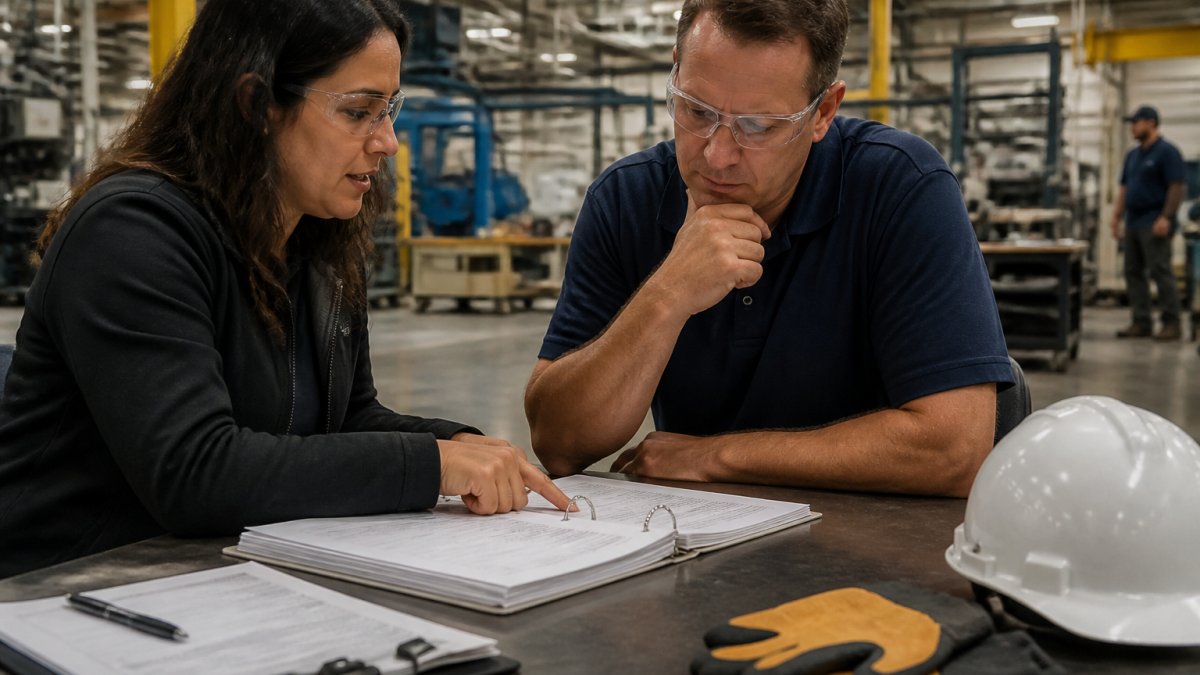
Screening for a manufacturing floor is not the same as screening for an office. Before a candidate walks your floor, four verification layers should be complete, and each one has a specific mechanism, not just a checkbox.
Layer 1: Identity and Work Authorization
Form I-9 verification is completed before the start date, with the employee’s identity and work authorization documents examined in person or through an authorized remote process. For temporary and contract workers, the agency is the employer of record and owns this step; for direct hires, your HR team does. Confirm in writing which party is responsible before the first day, because a gap here becomes your compliance problem, not the agency’s.
Layer 2: Safety History and Training Records
For skilled trades and maintenance roles, ask specifically about their experience with energy isolation on the equipment types in your plant. A maintenance technician who has only worked on de-energized equipment during scheduled downtime is not ready for live troubleshooting on a running line.
Layer 3: Credentials and Certifications
- Forklift and powered industrial truck operators. OSHA requires training and evaluation, and the employer must certify the operator. Ask whether the candidate’s prior certification is current and whether your plant will need to re-evaluate them under its own program.
- Crane and rigging. Overhead crane and rigging qualifications vary by equipment class; match the candidate’s experience to the specific crane types on your floor.
- Welding. Welding certifications are procedure-specific. A candidate certified on one process and position may not be qualified for another, so ask for the process, position, and thickness range they are certified on.
- Electrical. For industrial electricians, ask about their experience with the voltage classes and control systems in your plant, and confirm any state or local licensing requirements that apply to the work.
- Equipment-specific training. For controls and automation roles, ask which PLC platforms, drives, and robotics systems they have commissioned or maintained, platform-specific experience is the single strongest predictor of ramp time.
Layer 4: Skills Validation
Résumés overstate capability; hands-on checks do not. For maintenance technicians, a structured technical interview that walks through a real fault scenario on your equipment is more predictive than a written test. For engineers, a technical screen by someone who can distinguish ladder logic from structured text filters out mismatches before they reach your interview panel. For production roles, a brief practical evaluation of the actual tasks, assembly, measurement, machine operation, catches gaps that an interview misses.
Putting the Layers in Order
A common pattern is to compress the first three layers into a single pre-start checklist completed by the agency, with the skills validation done jointly by the agency and your plant supervisor. That split keeps the agency accountable for verification and keeps your team focused on the technical judgment only you can make.
Retention, Attendance, and Quality: Measuring Whether the Hire Actually Worked
For deeper tactics on keeping the workers you just hired, our article on how to reduce manufacturing turnover and keep skilled workers covers onboarding structure, shift fit, and the first-90-day checkpoints that make the difference.
Building Your Plant Staffing Plan with IntegrityJobs
IntegrityJobs is a woman-owned technical staffing agency with 30 years of placing engineering, manufacturing, IT, and skilled trades talent across Ohio. We offer flexible hiring solutions, including contract and contract-to-hire. Our core values are affordability, speed, fairness, and friendliness.
If your plant is facing hiring challenges, start with our guide to solving Ohio plant hiring challenges faster, then get in touch.
Frequently Asked Questions
What technical roles do manufacturing plants commonly need to fill?
Most plants hire across three tiers. Production and general labor roles cover assemblers, machine operators, and material handlers. Skilled trades and maintenance roles include maintenance technicians, electricians, millwrights, and CNC machinists. Engineering roles cover manufacturing, mechanical, electrical, controls, process, industrial, and quality engineers. Automation and robotics work adds controls technicians and programmers.
How does technical staffing work for manufacturing employers?
You share the role requirements, shift schedule, pay range, and must-have skills. The agency screens candidates for skills, credentials, and shift fit, then presents a shortlist. You interview and select. The agency handles payroll, workers’ compensation, and onboarding paperwork for contract and temp-to-hire placements. Direct-hire searches run the same way but the candidate moves onto your payroll from day one. Most plants start with a single hard-to-fill requisition to test the process before committing to a broader agreement.
When should a manufacturer use contract staffing instead of direct hire?
Use contract or temp-to-hire when demand is uncertain, when a specific project has a defined end date, or when you want to see attendance and performance on your floor before extending a permanent offer. Direct hire fits roles with long ramp-up times, such as controls engineers or process engineers, where you want the person committed from the start. Temp-to-hire is the middle path: a trial period of roughly 90 days, then conversion. Many plants run maintenance technician staffing on this model because retention is easier to judge in person.
What should a plant look for in a technical staffing agency?
Check four things. First, sector depth: does the agency place engineers and skilled trades, or only general labor? Second, geographic reach, especially if your plant sits outside the major metros. Third, screening method: ask exactly how they verify CNC programming, electrical troubleshooting, or quality inspection skills. Fourth, references from other manufacturers in the region. Ask how quickly they filled the last three maintenance technician roles and what the 90-day retention rate was on those placements.
Can a staffing agency handle a role that combines two skill sets, like CNC programming and quality inspection?
Yes, but ask how the agency screens for the combination rather than each skill separately. A workable approach is a practical assessment covering both: a programming task on the relevant control, plus a dimensional inspection exercise using calipers and micrometers against a print. Ask for the assessment outline in writing before you sign. Agencies that only match keywords on a resume will struggle with hybrid roles, so the screening method matters more than the job description.
How can employers reduce time to hire for manufacturing roles?
Three levers move the timeline most. Pre-agree on pay range and shift before the search starts, because approval delays are the biggest hidden cost. Keep interview loops to two rounds with a plant walkthrough included. Use a staffing partner with an existing pool of pre-screened candidates rather than posting and waiting. Plants that plan requisitions a quarter ahead, through manufacturing workforce planning, consistently fill faster than those reacting to a line going down.