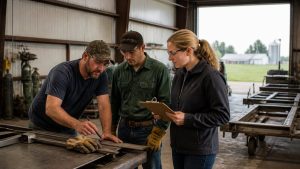


A production schedule can absorb a late shipment. It cannot easily absorb an empty maintenance shift, an unfilled welding station, or a machine operator who leaves after two weeks because the job was misrepresented. That is why a guide to skilled trades recruiting has to begin with the realities on the plant floor: safety, attendance, technical capability, shift coverage, and the cost of getting the hire wrong.
For Ohio manufacturers and industrial employers, the challenge is rarely a lack of applicants alone. The bigger issue is finding people with the right hands-on experience, confirming that experience efficiently, and presenting an opportunity they will actually accept. A better recruiting process does all three.
Guide to Skilled Trades Recruiting: Start With the Real Job
A job title is not a job description. “Maintenance Technician” can mean preventive maintenance in a clean, highly automated facility, or it can mean troubleshooting hydraulics and electrical systems during an overnight breakdown. “Welder” may require structural MIG work, precision TIG work, fitting, blueprint reading, or certification for a specific process.
Before posting a role or calling candidates, meet with the supervisor who will manage the new employee. Ask what the person will do in the first 30 days, what equipment they will touch, which skills are non-negotiable, and which can be taught. Clarify the shift, overtime expectations, physical demands, safety requirements, pay range, and the reason the position is open.
This conversation prevents a common recruiting failure: screening candidates against a wish list that does not reflect the actual work. A candidate who lacks one preferred credential but has years of directly relevant equipment experience may be a stronger hire than someone who matches every keyword on paper.
Separate requirements into three groups: must-have skills, trainable skills, and preferences. For example, an industrial electrician role may require the ability to read electrical schematics and troubleshoot 480-volt systems. Experience with one specific programmable logic controller platform may be trainable. A background in a particular industry could be a preference rather than a reason to reject an otherwise capable worker.
Build a Recruiting Plan Around the Local Market
Skilled trades recruiting is local, even when a job board makes the search look national. Commute distance, shift timing, parking, facility conditions, pay, and reputation all affect whether a candidate will consider an opportunity. In markets such as Akron, Canton, Cleveland, Columbus, and Dayton, employers may compete for the same small group of machinists, maintenance professionals, electricians, and production leaders.
Start with a realistic picture of the labor market. If the role requires a rare combination of experience, a fixed overnight schedule, and a long commute, the compensation and benefits must recognize that reality. If the pay range is below comparable local roles, increasing interview volume will not solve the problem.
The right approach depends on the urgency and difficulty of the role. A company hiring several entry-level production employees may benefit from a fast, high-volume process and a clear training path. A company replacing a senior tool-and-die maker or controls technician needs a more targeted search, deeper technical screening, and discretion. Treating both searches the same wastes time.
Your employment message should also be specific. Candidates want to know what they will work on, whether the equipment is maintained, how the team operates, when overtime occurs, and what advancement looks like. “Competitive pay” is less useful than a stated range. “Great culture” is less persuasive than explaining how supervisors train new hires, recognize good work, and communicate expectations.
Source Beyond the Active Applicant Pool
The strongest skilled trades candidates are often working. They may not be applying to advertisements, but they will listen when a role offers a meaningful improvement in pay, schedule, stability, location, equipment, or career path.
That makes targeted outreach essential. Recruiters should speak with candidates whose experience aligns with the work, not simply send the same message to everyone with a broad trade title. A CNC machinist who programs multi-axis equipment, for example, should hear why the machine environment, programming responsibilities, and schedule match their background.
Employee referrals can also produce strong candidates, especially when current employees trust the workplace enough to recommend it. Referral programs work best when they are simple, when employees understand which roles are priorities, and when the company gives feedback instead of letting referrals disappear into a system.
Training programs, trade schools, veteran networks, and former employees can add useful pipelines, particularly for roles where employers are willing to develop talent. These sources are not instant fixes for an experienced-worker shortage. They are long-term relationships that become more valuable when hiring needs increase.
Screen for Proof, Not Keywords
Resumes in skilled trades often leave out details that matter. A candidate may list “maintenance,” but that does not show whether they performed mechanical repairs, electrical troubleshooting, preventive maintenance, or only basic facility work. The first screening conversation should turn general claims into evidence.
Ask candidates to describe a recent issue they diagnosed, the steps they took, the tools or systems involved, and the result. For a welder, ask about materials, processes, positions, print interpretation, and quality checks. For a machinist, discuss tolerances, setups, controls, measuring tools, and whether they edited or created programs. The goal is not to conduct an interrogation. It is to understand what the person has actually done.
Verify the practical details early: work authorization, availability, shift preference, pay expectations, commute, certifications, and any essential physical or safety requirements. A technically qualified candidate who cannot work the required shift is not a fit, and discovering that after three interviews serves no one.
A structured scorecard helps keep the process fair. Evaluate every finalist against the same core criteria, such as technical experience, safety mindset, reliability, communication, and role-specific requirements. It reduces decisions based on vague impressions and gives hiring managers a clearer basis for comparison.
Move at the Speed of Good Candidates
Slow hiring is one of the most avoidable problems in skilled trades recruiting. Candidates with proven experience often have more than one option. If an employer takes a week to review a resume, another week to schedule an interview, and several more days to decide, the best candidate may already be gone.
Speed does not mean skipping due diligence. It means establishing the process before candidates enter it. Decide who reviews profiles, how quickly interviews can be scheduled, who has final approval, and what checks are required before an offer. Give candidates a realistic timeline, then meet it.
Communication matters just as much. A candidate who takes time off for an interview deserves a prompt update, even if the answer is no. Respectful communication protects the employer’s reputation in a tight labor market. It also keeps strong candidates open to future opportunities when the timing is not right.
Make the Offer Match the Conversation
Offers fall apart when the job changes between the first conversation and the final paperwork. Be direct about wages, differentials, overtime, benefits waiting periods, attendance expectations, and any pre-employment steps. If overtime is common, explain how often it occurs. If advancement requires additional training or a performance period, say so clearly.
Pay is central, but it is not the only factor. Some workers prioritize predictable hours. Others want higher earnings through overtime, a shorter commute, better equipment, a stable employer, or a path into leadership or technical specialization. Ask what matters before presenting an offer so the opportunity can be positioned honestly.
Once the offer is accepted, keep in contact through the start date. Confirm instructions, schedule, required documents, dress expectations, and the first-day point of contact. A preventable no-show often begins with uncertainty that nobody addressed.
Retention Begins Before Day One
Recruiting and retention are connected. If new hires receive little training, unclear direction, or a different work environment than they were promised, the organization will be recruiting the same role again soon.
A practical first-week plan makes a measurable difference. Introduce the new employee to the team, review safety procedures, explain production expectations, assign a knowledgeable point person, and check in after the first few shifts. Supervisors should ask direct questions: Is the work what you expected? Do you have the tools and information you need? Is anything unclear?
These conversations are especially valuable with experienced tradespeople. They do not expect every workplace to be perfect, but they do expect straight answers, functional equipment, and respect for their expertise.
For employers that need help finding hard-to-reach engineering, manufacturing, and skilled labor talent, IntegrityJobs.com brings a relationship-driven approach built on more than 30 years of recruiting experience in Ohio. Specialized recruiting support can be particularly valuable when internal teams need qualified candidates without sorting through a large volume of poor-fit applications.
The next opening is an opportunity to improve the process, not just fill a seat. Define the real work, communicate it honestly, evaluate candidates on proof of skill, and act with appropriate urgency. Skilled workers notice when an employer is organized and respectful – and that impression often begins before the first interview.