


Last Updated: October 26, 2026
Quick Summary
To reduce manufacturing turnover, measure voluntary separations by shift, role, tenure band, and supervisor before changing any hiring practice, then fix the worst segment first. Screen for shift tolerance, run 30-to-90-day onboarding with a named mentor, and address pay, schedule predictability, and supervisor effectiveness.
- Calculate turnover by dividing separations by average headcount, then multiply by 100.
- Track a 90-day quit rate as a standalone metric because it responds fastest to onboarding changes.
- Assign every new hire a named mentor on the same shift for the first week.
- Audit starting pay against at least five nearby employers’ posted wages for comparable roles.
- Pilot changes in the worst segment for 30 days before expanding to other shifts and sites.
Table of Contents
- Start With the Causes of Manufacturing Employee Turnover
- Measure Your Manufacturing Turnover Rate Before You Fix It
- Hire for Fit and Set Realistic Job Expectations
- Build Employee Onboarding for Manufacturing Workers That Sticks
- Invest in Manufacturing Workforce Training and Development
- Fix Pay, Shift Design, and Supervisor Effectiveness
- Run a Prioritized 30-60-90-Day Retention Plan
- Partner With IntegrityJobs to Stabilize Your Workforce
- Frequently Asked Questions
Start With the Causes of Manufacturing Employee Turnover
Most plants treat turnover as a hiring problem. It is usually a leaving problem. Workers quit because of what they experience after they are hired, not because of what happened during the interview. Understanding how to reduce manufacturing turnover starts with understanding why people walk out the door in the first place.
The pattern is consistent: the reasons people leave are rarely mysterious. They are predictable, and most are fixable.
Why Turnover Runs Higher on the Plant Floor
Frontline production work carries pressures that office roles do not. Shift work disrupts sleep and family life. Physical demands accumulate over months.
A common mistake is assuming pay alone drives departures. Pay matters, but supervisors, schedule predictability, and a sense of being set up to succeed matter just as much.
Watch out: writing a job description that oversells the role. It fills seats faster and empties them faster too.
Measure Your Manufacturing Turnover Rate Before You Fix It
You cannot fix what you have not counted, and most plants count the wrong thing. A single annual turnover percentage hides the operational reality: a plant reporting 20% overall may have 6% on first shift and 38% on nights, or 45% quits in the first 90 days and 8% after year one. For help forecasting skills and closing hiring gaps, see this manufacturing workforce planning guide.
Calculate the Right Rate the Right Way
The basic formula is straightforward: divide separations by average headcount for the period, then multiply by 100. Average headcount is (beginning headcount + ending headcount) / 2, not the number on the last day of the month.
But the headline rate is only the start. Separate voluntary from involuntary separations immediately. Involuntary terminations, layoffs, and no-call-no-show abandonments are not retention failures in the same way a resignation is.
Segment Before You Diagnose
Aggregate turnover is a lagging indicator that conceals the actionable patterns. Break every separation into at least five dimensions:
- Shift, first, second, third, and any 12-hour rotations. Night and swing shifts almost always run higher; if yours do not, you have something worth studying.
- Role and department, operators, maintenance technicians, material handlers, quality inspectors, and leads each have different exit drivers. Maintenance turnover often reflects on-call burden; operator turnover often reflects schedule and supervision.
- Tenure band, 0-30 days, 31-90 days, 91 days-1 year, 1-3 years, and 3+ years. Early quits point to hiring and onboarding; mid-tenure quits point to supervision and schedule; long-tenure quits point to pay compression and career ceilings.
A simple cross-tab of shift by tenure band will usually reveal the single worst leak in under an hour.
Build a Spreadsheet That Actually Works
You do not need an HRIS module to start. A shared spreadsheet with these columns covers 90% of what you need:
- Employee ID
- Role and department
- Shift
Code the stated reason to a fixed list, pay, schedule, supervisor, physical demands, career, relocation, attendance policy, other, so you can count patterns instead of reading anecdotes. Review monthly with plant leadership and quarterly with site management. The goal is not a prettier report; it is a short list of the two or three segments where intervention will move the most people.
Track a 90-day quit rate as a standalone metric. It is the fastest-moving retention signal you have, and it responds to onboarding and hiring changes within a quarter, long before annual turnover does.
Set Benchmarks You Can Defend
Be careful with published industry averages. Manufacturing turnover varies enormously by subsector, region, and wage level, and a national number will either lull you into complacency or send you chasing a problem you do not have. The more useful benchmark is internal: your own rate by segment, tracked over time, compared against your own prior quarters and against nearby competitors’ posted wages and schedules.
Hire for Fit and Set Realistic Job Expectations
The cheapest turnover fix happens before day one. Screen for shift tolerance, physical capability, and reliability, not just machine skills.
Job descriptions should state the hard parts plainly. Heat, noise, overtime, weekend rotations. Candidates who self-select out at that stage were never going to stay anyway.
For practical tactics on screening and speed without sacrificing quality, see how to hire manufacturing workers faster. Fit and pace are not opposites.
Build Employee Onboarding for Manufacturing Workers That Sticks
Strong employee onboarding for manufacturing workers runs 30 to 90 days, not one morning of paperwork.
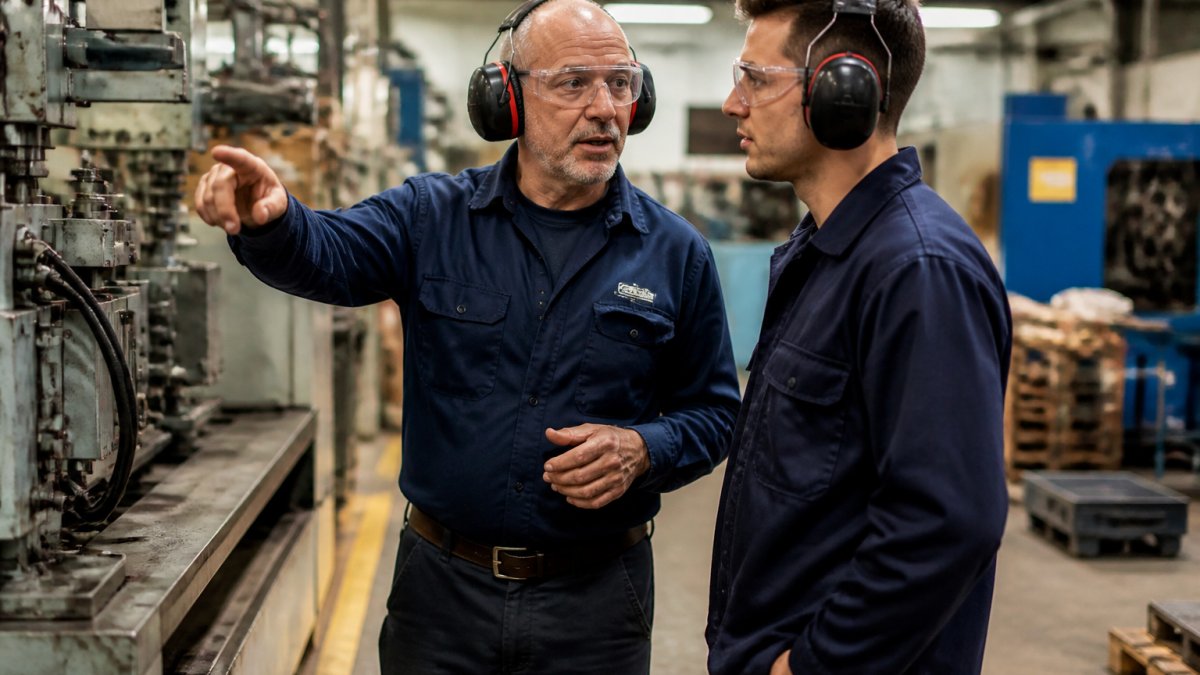
Structured onboarding beats orientation videos. New operators need to touch equipment, meet their actual crew, and understand how their work feeds the line.
Watch out: leaving a new hire alone on a shift before they are signed off. One bad night can end the relationship.
Invest in Manufacturing Workforce Training and Development
Workers stay where they can see a future. Manufacturing workforce training and development is a retention tool first and a skills tool second. Cross-training on multiple machines gives people variety and makes them harder to replace. A visible path from operator to lead to technician gives them a reason to stay past year two.
Practical moves that cost little:
- Post a skills matrix on the floor so workers can see what they have mastered and what comes next
- Fund certifications and pay for them on completion
- Rotate assignments so no one runs the same station for years
Career path clarity is one of the strongest retention levers available to plant managers, and it does not require a new budget line.
Fix Pay, Shift Design, and Supervisor Effectiveness
Three levers move turnover more than any others: pay competitiveness, schedule design, and how supervisors treat people.
On pay, benchmark against local rates for comparable roles and check your starting wage against what nearby plants advertise. Better coverage planning is the core of staffing overtime reduction.
Supervisors deserve the most attention. A good supervisor shields their crew from chaos and coaches instead of criticizes. A bad one drives people out regardless of pay.
Run a Prioritized 30-60-90-Day Retention Plan
Most retention advice fails not because the tactics are wrong but because plants try to do all of them at once, assign none of them, and measure nothing. A sequenced plan with named owners and a small set of metrics beats a long list of initiatives every time. The plan below assumes you have already segmented turnover by shift, role, and tenure, if you have not, spend the first two weeks doing that before anything else.
Days 1-30: Diagnose and Stop the Bleeding
Owner: Plant manager with HR.
Actions:
- Build the segmented turnover spreadsheet and identify the worst shift, role, and tenure band.
- Run exit interviews on every voluntary separation for the next 30 days, using a fixed question set so answers are comparable.
- Conduct stay interviews with a sample of 10-15 employees in the highest-turnover segment, asking what would make them stay and what would make them leave.
Metrics to establish as baselines: overall voluntary turnover rate, 90-day quit rate, and the turnover rate for the worst segment.
What not to do yet: do not launch a recognition program, redesign the career ladder, or buy engagement software. You do not yet know which problem you are solving.
Days 31-60: Fix the Highest-Impact Leak
Owner: HR lead with the supervisor of the worst segment.
Actions:
- Rewrite job descriptions for the highest-turnover role to state schedule, physical demands, and overtime expectations plainly.
- Assign a named onboarding mentor on the same shift for every new hire, with a 30-day training map signed off by the supervisor.
- Schedule check-ins at day 7, day 30, and day 90, with the supervisor asking a fixed set of questions and logging answers.
Metrics to watch: 90-day quit rate in the targeted segment, exit-interview reason codes, and stay-interview themes. Compare week over week, not month over month, at this stage.
Do not roll out changes to every shift and site at once. Pilot in the worst segment for 30 days, confirm the signal, then expand. A failed plant-wide rollout destroys credibility for the next attempt.
Days 61-90: Build the Pull and Prove It
Owner: Plant manager with operations and HR.
Actions:
- Post a skills matrix on the floor for the targeted role so workers can see what they have mastered and what comes next.
- Publish a visible path from operator to lead to technician, with the specific skills and time-in-role required at each step.
- Launch a simple recognition practice tied to the behaviors you want, safe handoffs, mentoring new hires, cross-training, delivered by supervisors in the moment, not by HR at quarter-end.
Metrics to report to leadership: 90-day quit rate before and after, voluntary turnover by segment, and the cost of the interventions versus the estimated replacement cost avoided. Even a rough replacement-cost estimate, recruiting spend, overtime coverage, training time, and lost productivity, makes the business case concrete.
What Good Looks Like at Day 90
You are not trying to eliminate turnover. You are trying to know, with numbers, which segment is leaking, which intervention moved it, and what it cost. A plant that enters day 91 with a segmented dashboard, a working onboarding mentor system, a corrected starting wage, and a published career path is in a far stronger position than one that launched ten initiatives and measured none.
The plan sequences retention work into three phases, each with a named owner and its own metrics.
| Phase | Owner | Key actions | Metrics |
|---|---|---|---|
| Days 1-30 | Plant manager with HR | Build segmented spreadsheet; exit interviews; stay interviews; pay audit; review no-call-no-shows | Voluntary turnover rate, 90-day quit rate, worst-segment rate |
| Days 31-60 | HR lead with worst-segment supervisor | Rewrite job descriptions; assign onboarding mentor; day 7/30/90 check-ins; correct wage gap; train supervisors | 90-day quit rate in targeted segment, exit-interview codes, stay-interview themes |
| Days 61-90 | Plant manager with operations and HR | Post skills matrix; publish operator-to-technician path; launch recognition; set and publish target | 90-day quit rate before and after, voluntary turnover by segment, cost avoided |
Partner With IntegrityJobs to Stabilize Your Workforce
Retention work takes time, and production cannot wait for it. That is where we come in. IntegrityJobs is a woman-owned staffing agency with 30 years of placing technical talent in manufacturing, engineering, IT, and skilled trades.
Our teams cover all 88 Ohio counties, including rural plants that national agencies overlook. If you need someone in the next few weeks, our manufacturing recruiter service is built around speed and fit.
Frequently Asked Questions
What is a good turnover rate in manufacturing?
There is no single benchmark that fits every plant, because turnover varies by role, shift, and region. The more useful approach is to compare your own manufacturing turnover rate against your prior year and against similar roles in your area. Track voluntary and involuntary turnover separately, then watch whether the rate improves after each intervention. A rate that is falling quarter over quarter, and that is concentrated in new hires rather than tenured operators, tells you your retention work is landing.
What are the main causes of manufacturing employee turnover?
The most common drivers are a mismatch between what the job was described as and what it actually is, weak onboarding that leaves new hires feeling unprepared, shift schedules that conflict with family life, pay that lags nearby employers, and supervisor relationships. Physical demands and workplace conditions matter too, especially on older lines. Exit interviews and stay interviews reveal which of these dominate at your plant, so you fix the real cause instead of guessing.
How can onboarding reduce turnover among manufacturing employees?
Structured employee onboarding for manufacturing workers shortens the period when new hires are most likely to quit. Assign a buddy on the same shift, set clear 30- and 60-day checkpoints, and confirm the person can actually perform the core tasks before adding complexity. Cover safety rules and shift handoff expectations in the first week. Check in at day 7, day 30, and day 90 to catch problems early, when a conversation can still save the placement.
How should manufacturers measure turnover and retention?
Calculate turnover by role, shift, and tenure band rather than as one plant-wide number, since a single figure hides where the losses happen. Track voluntary versus involuntary separations, average tenure at exit, and absenteeism alongside the rate. Add exit interview themes and stay interview feedback so you know why people leave, not just how many. Review the numbers monthly and tie each retention initiative to a change in the specific segment it targets.
Reducing turnover is not one initiative. It is a habit of measuring, listening, and fixing the leaks in order. If your plant needs skilled machinists and technicians who actually stay, get started with IntegrityJobs and build a workforce that holds together.